Writing Product Descriptions with AI: A Workflow That Keeps Quality Across a 200-Product Catalog
AI can write 200 product descriptions in an afternoon. The hard part is making sure all 200 are accurate, different from each other, and written in your brand's voice.

Short answer: writing product descriptions with AI is not a problem for Google; descriptions that drift from the source data or copy each other are. To keep quality, let AI write only from a verified attribute table, run every text through a fact check and a human editor, scan similar products for repetition, and publish with Product schema.
Manufacturer, online store, or B2B supplier, it makes no difference: a 200-product catalog takes weeks to write by hand. AI shortens that, but used without controls it brings a new problem: wrong dimensions, certifications that don't exist, the same paragraph on twelve variants. This article gives you a workflow that keeps quality without giving up the speed. If you want to know how AI tools describe your company, start with the 20-minute AI visibility check; product pages are among the sources those answers read most.
One attribute table per product. Every fact in the text comes from here.
Drafts from the table, in your brand voice, with a fixed template.
Fact check, human edit, and uniqueness: three quality gates.
Product schema, internal links, and improvements based on real data after launch.
AEO sentence: AI-assisted product descriptions are produced by having AI draft text in the brand voice from a product's verified attribute table, then passing that draft through a fact check, a human editor, and a repetition scan across variants before publishing it with Product schema. AI drafts, data decides, a human approves.
What does Google say about AI-written content?
In short: Google judges the result, not the tool. That doesn't mean anything written with AI is fine. The policy has two sides, and product catalogs sit right in the middle: thousands of pages, similar structure, automated production.
- Quality, not production method. Google states that its ranking systems focus on the quality of content rather than how it is produced, and that appropriate use of AI is not against its guidelines (Google Search Central: Google Search's guidance about AI-generated content).
- AI gives no special boost either. The same page says using AI doesn't give content any special gains: if it is useful, original, and trustworthy it may do well, and if not, it may not.
- The line: scaled content abuse. The spam policy treats generating many pages mainly to manipulate rankings, without helping users, as spam "no matter how it's created". One of its examples is exactly this: using generative AI tools to generate many pages without adding value for users (Google Search Central: Spam policies, scaled content abuse).
- Copied product text is a risk too. The "thin affiliation" section of the same page lists affiliate pages with product descriptions copied directly from the original merchant, without added value, as a problem. Having AI swap in synonyms doesn't fix that; the spam policy names automated transformations like synonymizing explicitly.
The practical takeaway: writing 200 products with AI is fine. Publishing 200 products without checking the attribute table, with near-identical, keyword-stuffed text, puts both your users and your rankings at risk. The workflow below turns that difference into concrete steps.
The Source-to-Shelf Line: an 8-step workflow
The framework we use at Mandalium on catalog projects is called the Source-to-Shelf Line. The logic fits in one sentence: AI drafts, data decides, a human approves. The eight steps fall into three phases; steps 4, 5, and 6 are quality gates, and no text goes live without passing them.
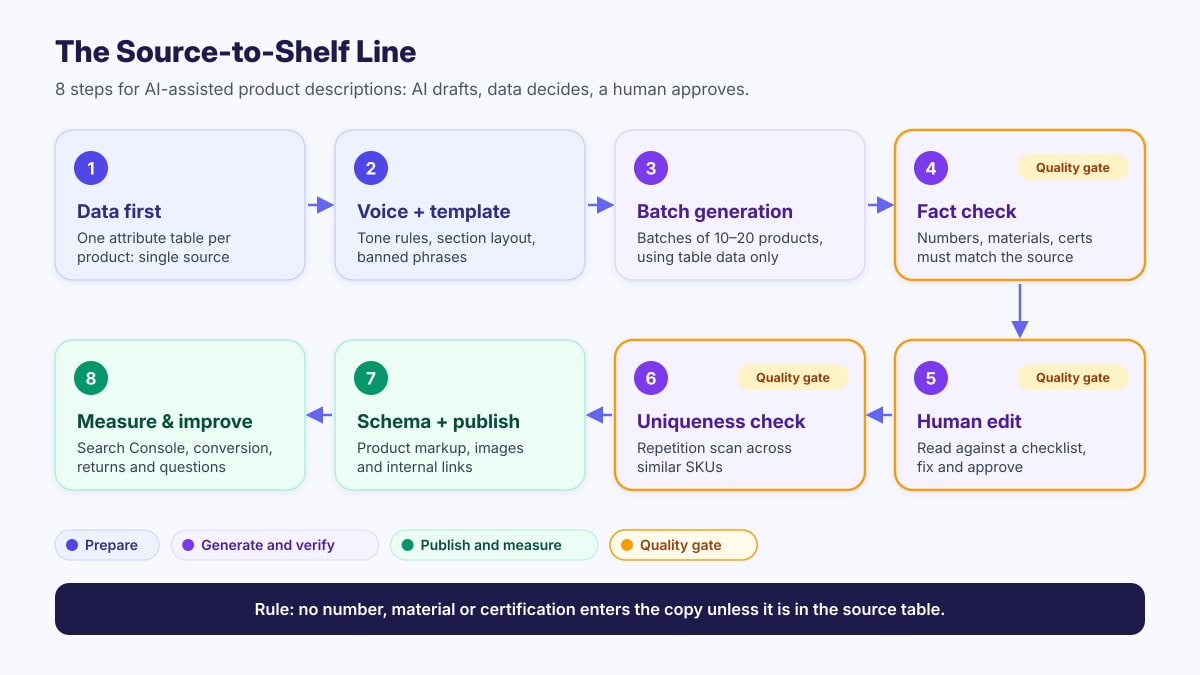
1. Data first: one attribute table per product
The biggest risk with AI is that it writes what it doesn't know in a fluent sentence. The fix is data, not a cleverer prompt. Build a one-row table per product: name, SKU, category, dimensions, weight, material, color/variant, use case, compatibility, certifications, warranty, care instructions, and one or two real differences from competing products. The source should be the spec sheet, the ERP/PIM record, or the manufacturer's documentation. An empty cell means "unknown", not "let the AI guess".
This is the step most teams want to skip because it is boring. But once the table exists, it feeds not only the descriptions but also Product schema, filters, comparison tables, and the Merchant Center feed.
2. Brand voice and a template prompt
Asking for "a nice description" product by product gives you 200 different styles. Use one template prompt, written once, with four parts:
- Voice rules. Formal or casual address, short or long sentences, how technical to get, and 2–3 sample paragraphs. Use a text the brand actually publishes.
- Fixed structure. For example: a one-sentence benefit opener, a paragraph on who it is for and what it does, a spec list, and a care or usage note. State the length range too.
- Banned phrases. "Must-have", "unmatched quality", "the best", unverifiable superiority claims, and health or safety promises that could cause legal trouble in your industry.
- Data rule. "Use only the information in the table provided. Do not write any number, dimension, material, certification, or warranty that is not in the table. If something is missing, write [MISSING: field name]."
3. Batch generation in small batches
Instead of generating all 200 at once, work in batches of 10–20 and review the first batch completely. Problems found in the first batch (openers that run long, repeated patterns, the wrong tone) go back into the template, and later batches come out cleaner. Store each text next to the table row it was generated from; the fact check depends on that pairing.
4. Fact check: AI is never allowed to invent specs
This step has one rule: every number, dimension, material, certification, and warranty claim in the text must appear in the source table exactly. In practice: pull every number and unit out of the text (a simple script, or a second AI call that says "list every claim in this text", can do it), then match each one against the table row. Text with a leftover [MISSING] tag, or anything that doesn't match, doesn't get published; it goes back to the product owner. For certifications such as CE, ISO, or food-contact compliance, the tolerance is zero: a wrong certification claim is a liability issue, not a marketing slip.
5. Human edit with a checklist
The editor doesn't rewrite the text; they read it against a checklist and fix what's needed. You'll find that checklist in the table below. Someone who knows the product (sales, product management, or engineering) should read the first batch, especially in B2B catalogs: only they catch errors like "technically correct, but nobody in the field says it that way".
6. Uniqueness: a repetition scan across similar SKUs
It is normal for AI to produce very similar text for 15 products in the same series. Before publishing, compare the texts of similar products side by side: the same opening sentence, the same benefit paragraph, or texts where only the color name changes get flagged. A simple similarity scan (a script or tool that compares sentences) shows this in minutes. The fix isn't always new text: putting variants that differ only in color or size on one parent product page is often better. Google's Product structured data supports variants separately (Google Search Central: Product structured data).
7. Schema and publish
Approved text goes live with Product schema, the right image and alt text, and internal links to the category and complementary products. The price, availability, and spec data in the schema should come from the same source as the page text and, if you have one, the Merchant Center feed; three different dimensions in three places mislead both users and search engines. Make sure the description appears in the page's raw HTML; text loaded only through JavaScript may never reach some AI bots (the View Source test).
8. Measure and improve
Check back 4–8 weeks after launch: impressions and clicks for product pages in Search Console, the step from product page to cart or quote form in GA4, "does this product fit X?" questions reaching customer service, and return reasons. A frequent question means missing information in the description; add it to the table and update the text. When you read the traffic, account for AI Overviews; we explained why a drop isn't always a loss in the zero-click search guide.
Quality checklist
Use this table as a shared list for the editor and the product owner. If any row is "no", the text doesn't go live.
| Check | Question | Who / how |
|---|---|---|
| Data match | Is every number, dimension, and material in the source table? | Script or second AI call + product owner |
| Certifications and warranty | Is there any certification, warranty, or standard claim without a document behind it? | Product owner, with the document |
| Missing fields | Is a [MISSING] tag left in the text? | Automatic search |
| Who and what for | Do the first two sentences say whose problem it solves? | Editor |
| Brand voice | Does the style match the sample paragraphs, with no banned phrases? | Editor |
| Natural language | Does the keyword read naturally, or is it repeated? | Editor, reading aloud |
| Uniqueness | Does it share an opener or paragraph with products in the same series? | Similarity scan |
| Schema consistency | Do the schema, page text, and feed give the same facts? | Rich Results Test + spot checks |
Tip: Keep the checklist as a spreadsheet column (pass/fail per row). That way you see at a glance where each of the 200 texts got stuck.
Time math for 200 products (example estimate)
The figures below are an example estimate, not measured data: they assume a 200-product catalog of medium complexity with spec sheets already available. For your own catalog, timing the first batch of 20 products and multiplying by 10 gives a far more reliable estimate.
| Step | Written by hand | AI-assisted workflow |
|---|---|---|
| Attribute table / data collection | 200 × 10 min ≈ 33 h | 200 × 10 min ≈ 33 h |
| Template and prompt setup | — | ≈ 6 h (once) |
| Writing / generation | 200 × 30 min = 100 h | ≈ 3 h (in batches) |
| Fact check | Part of writing | 200 × 4 min ≈ 13 h |
| Editor read | 200 × 5 min ≈ 17 h | 200 × 8 min ≈ 27 h |
| Uniqueness scan | — | ≈ 3 h |
| Total (example) | ≈ 150 hours | ≈ 85 hours |
In this example the saving is about 43%. The point to notice: almost all of it comes from the writing row. Data collection doesn't shrink at all, and review and editing time goes up. The "AI writes 200 products in 3 hours" math comes from counting the checks as zero; skip those checks and the time you saved comes back as returns and corrections.
Before / after: one product description
The product below is an invented example and has nothing to do with a real brand or product. Attribute table: Liva 750 ml vacuum flask; inner and outer body 18/8 (304) stainless steel; keeps drinks hot for 12 hours and cold for 24 hours when filled at 95°C (manufacturer test); 390 g; screw lid with silicone seal; BPA-free PP lid; body hand wash only, lid top-rack dishwasher safe; 2-year warranty.
"The Liva Flask, with its quality materials and stylish design, will become your everyday must-have. It keeps drinks hot for 24 hours, and its leak-proof build and dishwasher-safe body make life easy. The best flask for anyone looking for the best flask!"
Problems: 24 hours hot is invented (the table says 12); the body isn't dishwasher safe; no capacity, material, or warranty; repeating "best flask" is keyword stuffing; unclear who it is for and why.
"So the tea you pour in the morning is still hot in the afternoon: filled at 95°C, the Liva 750 ml keeps drinks hot for 12 hours and cold for 24 (manufacturer test). The inner and outer body are 18/8 (304) stainless steel, and the silicone seal in the screw lid stops leaks when the flask lies flat in a bag. At 390 g, it won't weigh down your everyday bag."
List below: Capacity 750 ml · Weight 390 g · Lid: BPA-free PP · Care: body by hand, lid top rack · Warranty: 2 years.
The second text isn't longer, it is more informative. Every claim comes from the table, a real moment of use ("when the flask lies flat in a bag") is written as a benefit, and it is specific enough to stand apart from the 500 ml model in the same series.
Common mistakes
AI fills missing information with a plausible-looking number. Without the table and the [MISSING] rule, this is unavoidable.
Twelve pages where only the color name changes add nothing for users. Group variants on one page or write the difference.
Repeating "stainless steel flask" five times tires readers and matches an example in Google's spam policy.
AI text without a template sounds the same for every brand. Sample paragraphs and a banned-phrase list keep you distinct.
Copied text with synonyms swapped in isn't original. The value comes from the use and compatibility details you know.
Generating 200 texts and then reviewing them means fixing the same mistake 200 times. Review the first batch and fix the template.
Conclusion: speed from AI, trust from data
Short answer: writing a 200-product catalog with AI is possible and legitimate in Google's eyes; what keeps quality is tying every fact in the text to the source table and never skipping the three quality gates (fact check, editor, uniqueness). Start with a pilot batch of 20 products, time it, fix the template, then scale.
Related guides: AI visibility check, llms.txt guide, zero-click search, B2B: catalog or conversion-focused site?, View Source test.
When we build the site that carries your product catalog, Mandalium connects the product page template, Product schema, and measurement to the same data source. Let's plan a pilot for your catalog →
Sources: Google Search Central — Google Search's guidance about AI-generated content; Google Search Central — Spam policies for Google web search (scaled content abuse); Google Search Central — Introduction to Product structured data.
Frequently asked questions
Are AI-written product descriptions a problem for Google?
Not by themselves. Google says it focuses on the quality of content, not how it is produced. Its spam policy targets large numbers of pages generated mainly to manipulate rankings without adding value for users. Descriptions that are based on source data, fact-checked, and specific to each product do not fit that definition.
How do I stop AI from inventing product specs?
Give the AI only the product's attribute table and add a rule to the prompt: "do not write any number, material, or certification that is not in the table; if something is missing, write [MISSING]". Then run a fact check that matches every number, dimension, material, and certification in the text against the source table. Text that doesn't match doesn't get published.
Should I write a separate description for each color and size variant?
Usually not. For variants that differ only in color or size, one parent product page with a variant selector works better, and Google's Product structured data supports variants. If you need separate pages, keep the shared part short and lead with what is specific to the variant (dimensions, use, compatibility).
How long does it take to write a 200-product catalog with AI?
In this article's example math, writing by hand takes about 150 hours and the AI-assisted workflow about 85 hours. These are example estimates, not measured data. The savings come from the writing step; data collection and human review do not get shorter, and they shouldn't.
Do I need to disclose that a product description was written with AI?
Google finds AI or automation disclosures useful for content where readers might wonder "How was this created?" and suggests adding them when that is reasonably expected. For product descriptions that expectation is usually low; what readers expect is accurate information and a brand that stands behind it. If your industry has a specific legal rule, follow it.
Do product descriptions need Product schema?
It isn't required, but it is recommended. Product structured data helps information such as price, availability, and ratings appear in richer ways in Google results. The schema should match the text on the page and your Merchant Center feed, and every number in the description should come from the same source.

Tugay Mandal
Founder of Mandalium. 6+ years of experience in corporate websites, web products and SEO.
About Us