What Is llms.txt and What Does It Do? Preparing Your Site for AI Summaries
llms.txt is a plain-text guide at your site root. It tells AI consumers “read this first.” It is not a W3C standard and not a Google ranking guarantee. It is still a clear, low-cost signal in the AEO and GEO layers.
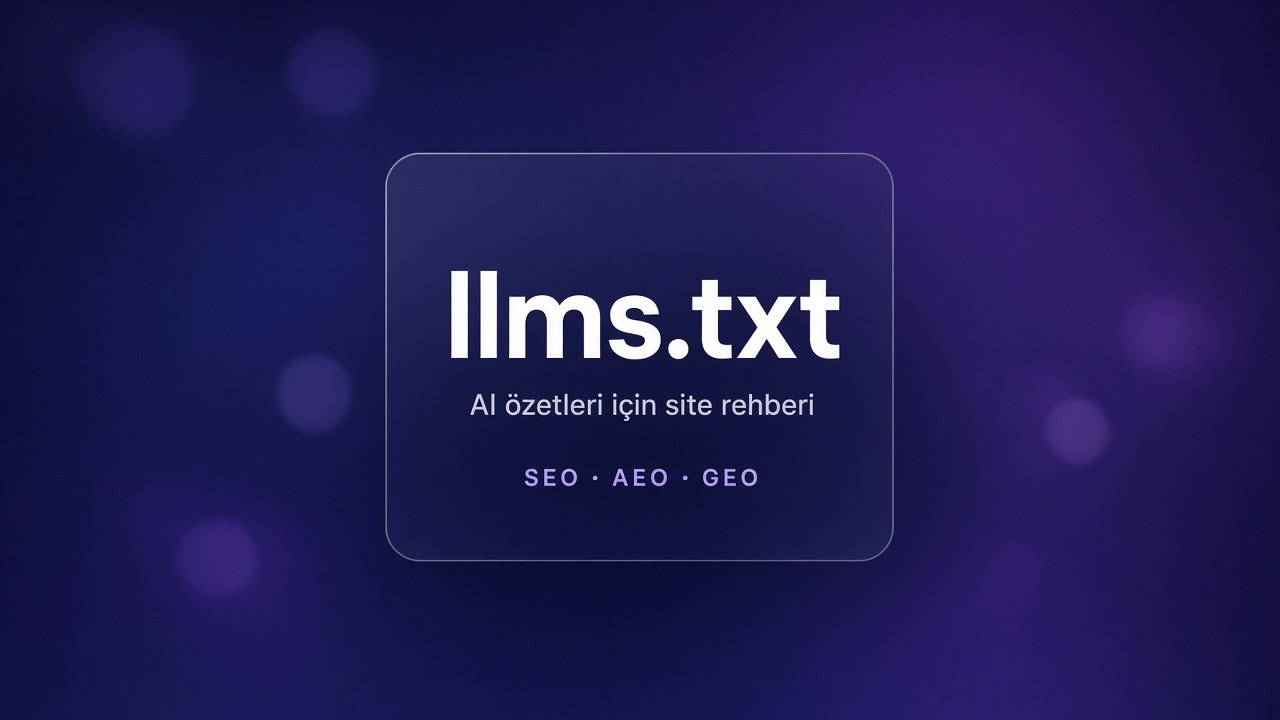
Short answer: llms.txt is a plain-text guide you put at the site root. It tells AI consumers “read this first, these pages are safe to summarize, skip those.” It is an emerging convention. It is not a W3C standard. It does not guarantee Google rankings. It still leaves a clear, low-cost signal in the SEO, AEO, and GEO layers.
In the field many SME sites tick robots.txt and sitemap.xml and call it done. AI summaries still pull from an About box, an old PDF, or a wrong service line. llms.txt does not fix a weak site. It does gather the right skeleton in one file. Below: what it is, how it differs from robots/sitemap, what to write, and a 5-step publish list.
At the root: /llms.txt. Not HTML, not behind a login — a readable guide.
Gives context to ChatGPT, Gemini, Perplexity, and similar summary engines.
Emerging practice. Not a standard or a ranking promise — a clarity tool.
robots + sitemap + llms.txt. Together; none substitutes for another.
1. What is llms.txt?
llms.txt is a plain-text file published at your site root. Its job: tell LLMs and AI agents who you are, which pages are reliable to summarize, and what to skip — in short, structured language.
- What it is not: a W3C standard, a Google Search ranking factor, or a “rank #1 in AI” switch.
- What it does: gives summary engines context. It lowers the risk of the wrong sector, city, or outdated service list.
- Who uses it: an emerging convention; some AI crawlers and tools look for this file at the root. Adoption is growing, not universal.
AEO sentence: llms.txt is a plain-text guide at the site root. It tells AI consumers who you are and which URLs to summarize; it does not replace robots.txt or sitemap.xml.
2. Why it matters — with SEO, AEO, GEO
Classic SEO aims to rank in blue links. AEO aims to be quoted in featured snippets and answer engines; GEO aims to be cited in generative engines. They are layers, not rivals — we unpacked that in SEO / AEO / GEO differences.
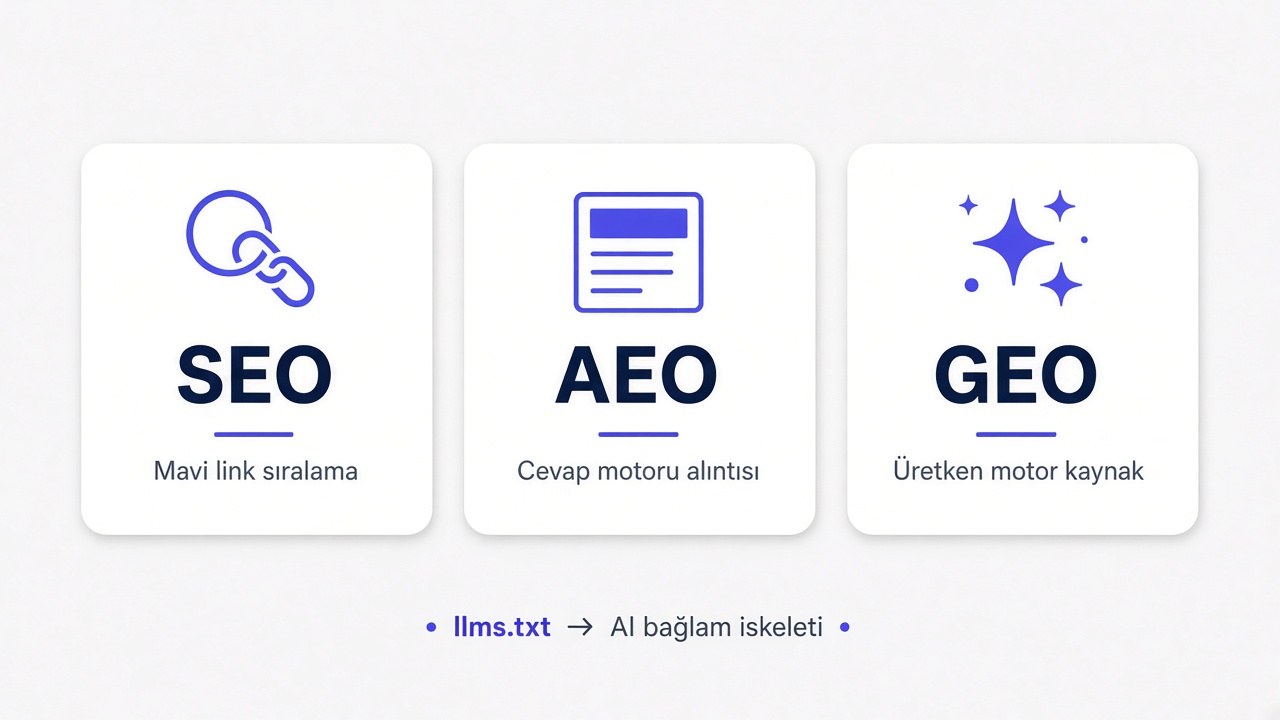
llms.txt is the “short skeleton” piece of those layers. If your pages are weak, the file will not save you. If your pages are full, it is a practical way to say “read here first.” At Mandalium we keep an llms.txt at our own root and fold blog and region summaries into it.
3. robots.txt vs sitemap.xml vs llms.txt
Three files get mixed up. Their jobs differ:
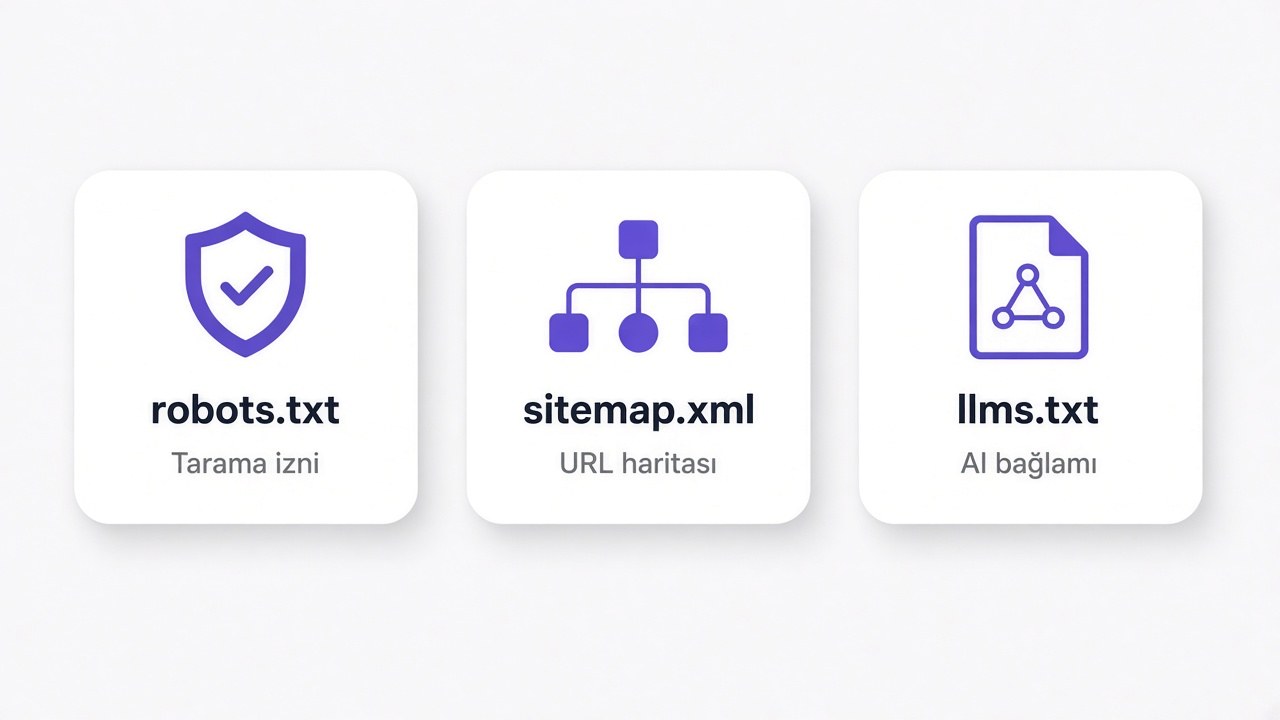
| File | Job | Audience | Relation to llms.txt |
|---|---|---|---|
| robots.txt | Crawl allow / deny | Bots | Permission layer; no context |
| sitemap.xml | URL inventory | Search engines | Lists URLs; does not say why they matter |
| llms.txt | Context + priority | LLM / AI consumers | Human-language guide |
4. What to write / what not to write (SME)
- Who + where + how you work (1–3 sentences)
- Service list (no hype)
- Featured page URLs
- Citable short summaries (question → one-line answer)
- Contact and language note
- Secret pricing, client confidentials, contract text
- A full dump of every blog post (link instead)
- Unsupported “#1 in the country” claims
- Every thin URL repeated
- Summaries that stay stale for months
Simple rule: shorten what is already true on the site. A service that exists only in the file is a bad source for AI.
5. A practical skeleton
The skeleton below is for a generic SME. Mandalium uses a similar shape at the root: identity, services, featured pages, blog links, citable summaries, contact.
# Company Name

> One-line offer. City / region. On-site or remote.

Short paragraph: who you are, who you serve, geography boundary.

## Services
- Service 1
- Service 2

## Featured pages
- Home: https://example.com/
- Services: https://example.com/services
- Contact: https://example.com/contact

## Citable summaries
- What do you do?: ...
- Where do you work?: ...

## Contact
- Email / phone / address
Markdown-like headings are fine; readability is the point. Do not embed JSON-LD or HTML. As the file grows, avoid the “paste everything” trap — pick priority URLs.
6. A 5-step publish checklist
- 1. Draft from the live site. About, services, contact — shorten; do not invent.
- 2. Publish at the root.
https://yourdomain.com/llms.txt— not a subfolder. - 3. 200 + plain text. No login, no HTML error page, no wrong Content-Type.
- 4. Do not contradict robots/sitemap. Do not feature a URL you disallow.
- 5. Update when blog/services change. New post or region page → refresh the summary too.
7. Common mistakes
- Treating llms.txt as a sitemap replacement
- Hype claims with no proof on the site
- Pasting 40 blog bodies into the file
- Burying the file under
/blog/llms.txt - Publishing once and forgetting — a 6-month-old service list
- Inflating the file with “AI ranking guarantee” marketing copy
Conclusion: a clear skeleton, no hype
Short answer: llms.txt is a root plain-text guide for AI summaries. It is not a standard or a ranking promise. It works with robots.txt and sitemap.xml. For SMEs the value is keeping it short and true.
Clarify your offer and service URLs first; then write the file. An empty site plus a full llms.txt does nothing. A full site plus a short llms.txt leaves a clean AEO/GEO signal.
At Mandalium we build the page skeleton first on SME sites, then the robots / sitemap / llms.txt trio. Is your AI-summary skeleton clear? Book a free look →
Frequently asked questions
What is llms.txt and what does it do?
llms.txt is a plain-text guide placed at the site root. It tells AI and LLM consumers who you are, which pages are safe to summarize, and what to skip. It is an emerging convention — not a W3C standard or a Google ranking guarantee.
Does llms.txt replace robots.txt or sitemap.xml?
No. robots.txt is crawl permission, sitemap.xml is a URL inventory, and llms.txt is human-language context and priority. They work together; none replaces another.
Will llms.txt improve my Google rankings?
No. It is not presented as an official ranking factor. Its job is a clearer skeleton for AI summaries and citations. It complements SEO, AEO, and GEO — it does not replace them.
Do small SME sites need an llms.txt?
It is not mandatory. If your offer is clear, your service URLs are filled, and you do not want AI summaries to misstate you, it is a low-cost signal. An empty or exaggerated file is worse than no file.
What should (and should not) go into llms.txt?
Include: who you are, services, featured page URLs, short citable summaries, contact. Skip: secret pricing, client confidentials, full blog dumps, unsupported claims, every thin URL. Keep it short, accurate, and current.
Where do I publish it and how do I verify?
Publish at the root: https://example.com/llms.txt. It must return HTTPS 200, be plain text, and not sit behind a login. Open it in a browser after deploy; avoid redirect chains and HTML error pages.

Tugay Mandal
Founder of Mandalium. 6+ years of experience in web design, mobile apps and SEO.
About Us