B2B Website: Catalog or Conversion-Focused Site?
A catalog shows the product. A conversion-focused site walks the buying committee onto the shortlist and produces a qualified quote. In B2B the real question is not which to pick — it is where the catalog belongs.
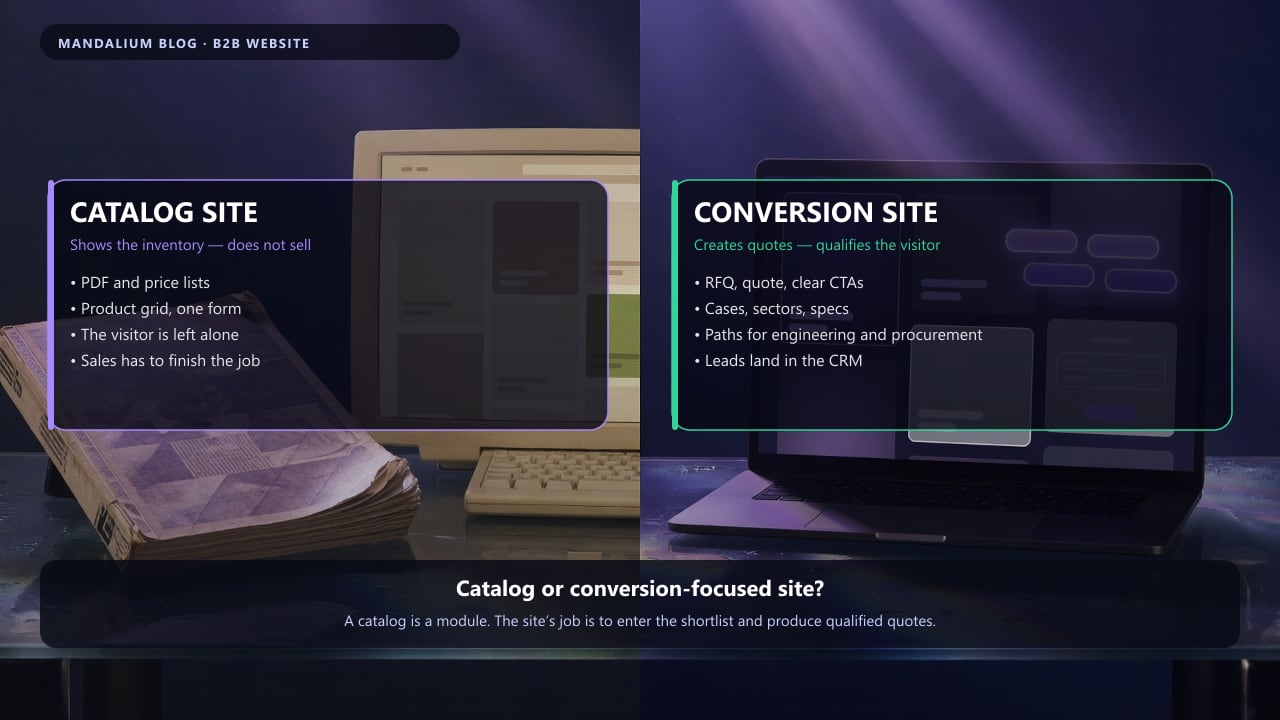
Short answer: B2B companies should not ship a catalog site; they should ship a conversion-focused site. The catalog is not deleted. It stops being the spine. Product lists, PDFs, and plant photos inform the buyer. What gets you on the shortlist, fills an RFQ, and hands sales a qualified file is the offer, proof, path, and measurement layer.
In Turkey — and in most industrial markets — a typical manufacturer, supplier, or B2B services site is still a digital brochure: a slider, a product grid, “download the catalog,” a contact form in the footer. In the 2026 buyer journey that structure can create visibility. It struggles to create quotes. This article separates the two models, lists the field signals, and spells out the catalog-plus-conversion hybrid.
Shows the product, SKU, and spec. It is a discovery layer, not a close layer.
RFQ, quote, demo, qualified lead. The file the site hands to sales.
A B2B decision is not one person. Engineering, procurement, and leadership finish different jobs on the same site.
A searchable catalog plus a conversion skeleton. That is the 2026 default for mature B2B sites.
1. What does a B2B buyer expect from a site in 2026?
The old assumption: the site is a storefront, sales closes. Field work and research flipped that. Buyers finish most of the job before they talk to a seller:
- 6sense 2025 Buyer Experience: about 61% of the journey is done before first sales contact (it was ~69% the year before). 95% of winning vendors were on the Day One shortlist. Most buyers already have a preferred vendor before first contact.
- Forrester, The State of Business Buying 2026: a typical decision includes 13 internal stakeholders + 9 external influencers. 94% of buyers use generative AI in the purchase process.
- Gartner (2026): 67% of buyers prefer a rep-free experience; 70% prefer a fully digital / self-serve path. In the same research 45% used GenAI to gather vendor/product information; 69% still want a seller to validate AI output at key points.
Translation: your site has to give engineering a spec, procurement a risk picture, and leadership a rationale before a sales call. A catalog does one of those jobs (show the product). The conversion layer carries the rest. That is also why SEO, AEO, and GEO are a shortlist problem, not a traffic problem — the buyer looks for you in Google, in an AI summary, and in your PDF at the same time.
AEO sentence: A B2B website is not a catalog standing in for a sales rep. It is a decision environment the committee can move through on its own. The vendor that is never spoken about is usually not on the shortlist either.
2. What is a catalog site — and why is it so common?
A catalog site moves the printed brochure onto a screen. Typical skeleton:
- Corporate home (“30 years of experience,” a slider, ISO marks)
- A product or machine grid (photo + two lines of copy)
- A downloadable PDF catalog
- About / plant tour
- A single Contact form
The model is cheap and familiar. It covers the trade-show booth, the sales deck, and the “we have a website” requirement. The problem is that the 2026 buyer does decision work on the site. 6sense data shows most identifiable account visitors stay anonymous; form-fillers are a thin slice of traffic. One generic form can fill even that slice with the wrong person (a student, a competitor, a general info request).
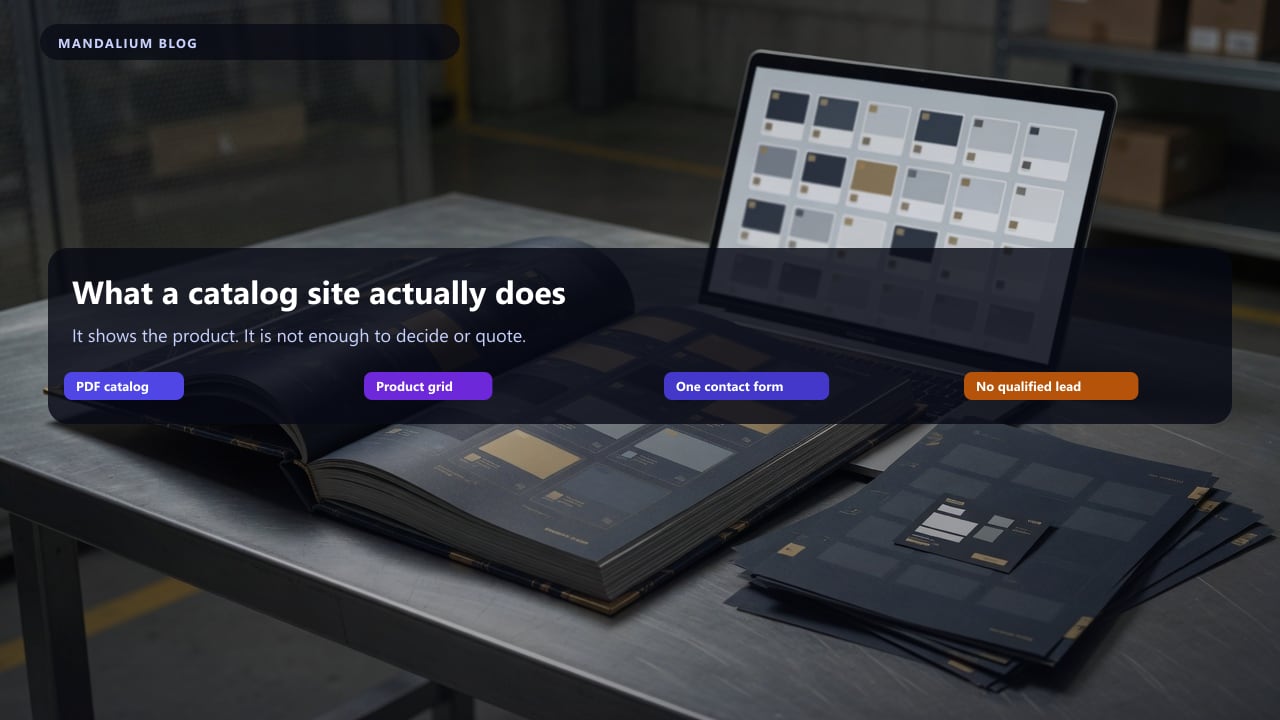
Field symptoms of a catalog site
- The main message is how established you are, not what you sell.
- Product pages have no filters, equivalents, tolerances, certificates, or applications — only photos.
- The CTA is “call us for details.” There is no RFQ, spec, or “quote this model.”
- Cases, industry proof, or “we ran this on that line” live only inside a PDF — or nowhere.
- The form has 8–12 fields; CRM records it as “web” with no qualification.
The catalog is not wrong. What is wrong is letting the catalog be the site’s only job. Searchable product/capability pages are the spine of B2B SEO. A spine is not a body.
3. What is a conversion-focused B2B site?
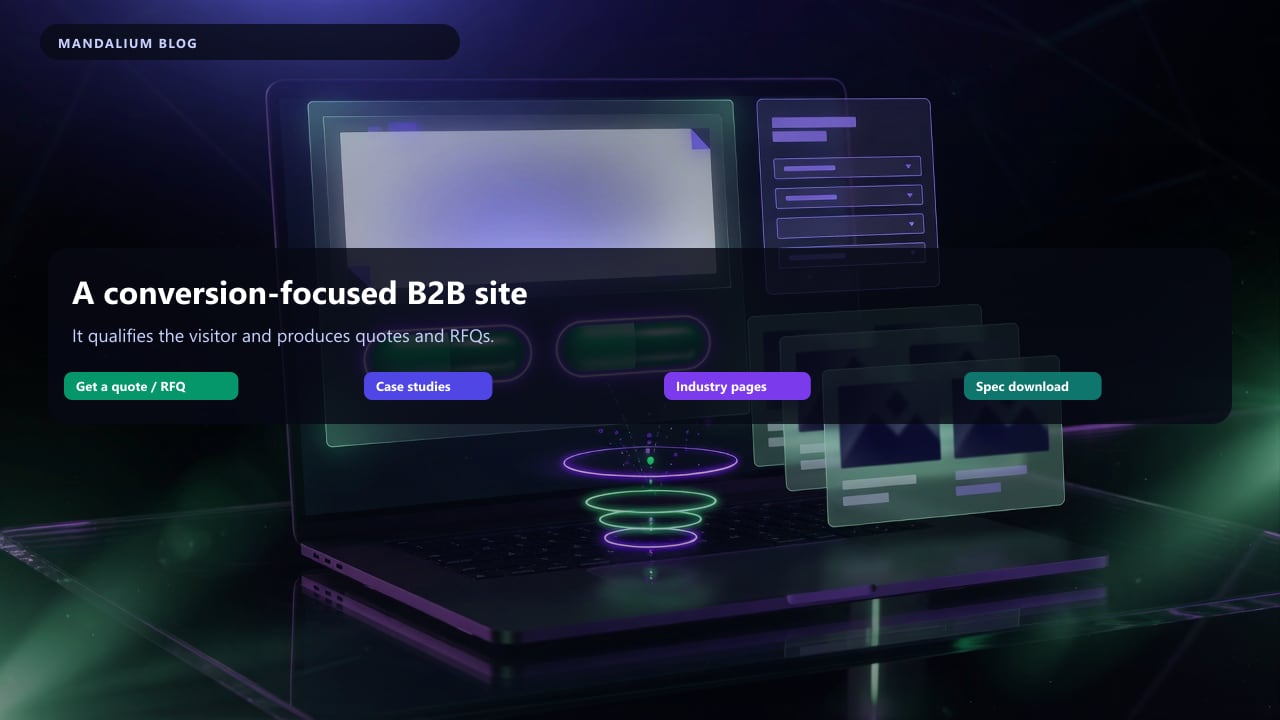
A conversion-focused site ties every template to a sales job. The ecommerce “add to cart” becomes the next step that earns a quote, RFQ, or demo. The site does all of this at once:
- In five seconds it says who you serve, which problem, in what scope.
- It gives engineering, procurement, and the decision-maker separate content and CTAs.
- It leaves low-commitment paths: specs, CAD, comparisons, calculators — most visitors, as 6sense underlines, research without filling a form.
- It separates high-intent paths: “Quote this product,” “Send the project,” “Talk to an engineer.”
- It writes the lead into the CRM with source, page, and intent.
Grey Matter’s 2026 compilation (Ruler Analytics, 100 million+ interactions) puts median B2B site conversion at 2.9%: roughly 1.7% forms, 1.2% calls. A healthy band for most B2B is 2–5%; enterprise / long-cycle deals often sit at 0.5–1.5%. Unbounce data shows single-job landing pages run higher than sitewide traffic (median 6.6%). So before you declare “1.2% means we are failing,” lock what you count, the channel, and deal size. A newsletter signup is not an RFQ.
Practical truth
On Mandalium projects, the real problem on catalog-only SME sites is not traffic. It is that the visitor cannot find the next step. A new theme does not close that leak. Redesign versus rebuild is decided here too: if the skeleton is sound, adding a conversion layer on the current URLs is often enough.
4. Comparison: catalog vs conversion
Numbers vary by sector. The job split does not:
| Criterion | Catalog site | Conversion-focused site |
|---|---|---|
| Job | Show | Produce a decision + a quote |
| Primary CTA | Contact / download PDF | RFQ, quote, demo, talk to engineering |
| Buyer roles | One page, same copy for everyone | Paths for engineering / procurement / leadership |
| Content | Product photos, generic capacity | Applications, cases, specs, comparisons |
| SEO / AEO | Thin pages, PDF-heavy | Q&A, schema, citable blocks |
| Measurement | Sessions, pageviews | RFQ, opportunity, pipeline, source page |
| Sales work | Discovery from zero | Close a qualified file |
Catalog is not “cheap” and conversion is not “expensive.” What is expensive is wiring trade shows, a sales team, and ad spend to a storefront that cannot produce a decision. Lost quotes over 12 months dwarf the theme line item.
5. Eight building blocks of a conversion-focused B2B site
A one-sentence offer
Not “industrial components”: who, which problem, what scope, which geography. Sector + outcome visible in the hero.
Industry / application pages
Food, automotive, energy… The buyer finds themselves on the page. The committee hears “they know our work.”
A searchable catalog (as a module)
SKU, tolerance, material, certificate, equivalent. The PDF is backup; canonical content is HTML. Google and AI digest PDFs poorly.
Page-level CTAs
On a product: “quote this model.” On a case: “talk about a similar line.” On a post: “book discovery.” One nav link is not enough.
Short, intent-led forms
HubSpot compilations show completion dropping as fields go from three to seven. RFQ: product, quantity, application, contact. Enrich job title later.
Proof: cases, references, certificates
Committees reduce risk. “Plant X, line Y, timeframe Z” sells more than a slogan.
Speed, mobile, a form that actually works
Core Web Vitals are not a vanity score here: a slow LCP and a broken form quietly kill the RFQ.
CRM and source trail
Which page, which CTA, which product. Sales cannot qualify “it came from the web.” They can qualify a page name.
6. Hybrid: do not delete the catalog, do not make it the spine
For most B2B manufacturers and distributors the right answer is not “throw away the catalog, ship a landing page.” The right answer:
- Keep winning product and capability URLs as an HTML catalog (filters, specs, equivalents).
- Make the PDF a backup download; it must not be the only source of content.
- Add RFQ + a related application + one case to every product/capability template.
- Pull home and industry pages onto an offer + proof + CTA skeleton.
- Merge thin, duplicate, dead product pages — catalog bloat hurts SEO too.
That turns corporate web design from “a nicer theme” into a sales system. At Mandalium the default B2B scope is this: catalog as a module, conversion as the skeleton.
7. A 30-minute decision matrix
Mark yes/no in the meeting. Three or more conversion signals and a visual refresh is not enough:
- Only CTA: contact or PDF
- No application / filter on product pages
- No cases — or a “our clients” logo strip
- The form asks no qualifying questions
- Sales discards web leads as “not serious”
- Page-level RFQ / quote CTAs
- Industry + product + case interlink
- Specs in HTML, PDF as backup
- 3–5 field form, source trail exists
- Sales finds inbound files “ready”
If you are unsure, a one-week conversion audit is enough: homepage offer, 10 product templates, form log, product queries in Search Console, quality of the last 20 web leads. Cheaper than a wrong 40-page PDF refresh.
8. Common mistakes
- Treating a 40-page PDF as “we did SEO” (weak indexing, almost no AEO/GEO)
- Dressing a B2C ecommerce theme onto B2B (a cart, no RFQ)
- Cloning every product with the same 120-word blurb
- Building a 12-field form and waiting for “qualified leads”
- Burying the phone number in the footer and never measuring call conversions
- Publishing a blog with no links into service or product pages (traffic stranded on an island)
Conclusion: catalog or conversion?
Short answer: build a conversion-focused site and place the catalog inside it as a module. “Let’s show our products” is not a sufficient B2B goal. The goal is for the committee to put you on the shortlist and for sales to sit down with a qualified RFQ.
In 2026 most of the buyer journey finishes before sales, AI enters the research, and the committee gets larger. A catalog is still necessary in that environment — it is not sufficient on its own.
At Mandalium we build the offer, RFQ, and proof skeleton first on B2B sites, then the searchable product layer. Is your site a catalog or a conversion engine? Book a free look →
Frequently asked questions
Should B2B companies build a catalog site or a conversion-focused site?
A conversion-focused site is the right default. A catalog can be a module; it should not be the whole site. In 2026 most of the B2B journey finishes digitally before a sales conversation. If the site never reaches the shortlist, no catalog is rich enough to create a quote.
What is the difference between a catalog site and a conversion-focused site?
A catalog site displays products, PDFs, and capacity, then leaves the visitor on a single contact form. A conversion-focused site gives engineering, procurement, and leadership separate paths, RFQ or quote CTAs, cases, spec sheets, and a measurable lead flow.
Should we remove the product catalog entirely?
No. A searchable, filterable, spec-rich catalog is critical for B2B SEO and technical evaluation. What you remove is not the catalog — it is the habit of letting the whole site behave like one.
What is a good conversion rate for a B2B website?
Industry research puts the median B2B site conversion near 2.9% (forms plus calls). Most B2B sites sit between 2% and 5%; enterprise and long-cycle deals often land at 0.5% to 1.5%. The score that matters is not form count — it is leads that become qualified opportunities and pipeline value.
Which pages does a conversion-focused B2B site need?
A homepage with a clear offer, industry/application pages, filterable product or capability pages, case studies, downloadable specs, an RFQ or quote form, and a trust-heavy contact page. A single Contact Us form is not enough.
Is a conversion-focused site too large a project for a small manufacturer?
No. A first release can be 6–10 pages: home, 2–3 industries, 4–8 featured products or capabilities, 2 cases, RFQ, contact. That is smaller than uploading a 40-page PDF — and it produces more quotes.

Tugay Mandal
Founder of Mandalium. 6+ years of experience in web design, mobile apps and SEO.
About Us